

Our February survey ran for five days and received 4186 responses, making it one of the largest workload survey of teachers in Northern Ireland in recent years. It focused on clause 8.1.b in the Jordanstown Agreement, which we refer to as the “Zombie” clause. This clause is used to justify teachers working at home in their own time, without pay. It is unfortunately still used – most recently in our February pay offer text – even though it has been widely contextualised and watered down through successive workload agreements.
Here are the key results.
Most teachers think Jordanstown 8.1.b is unfair.
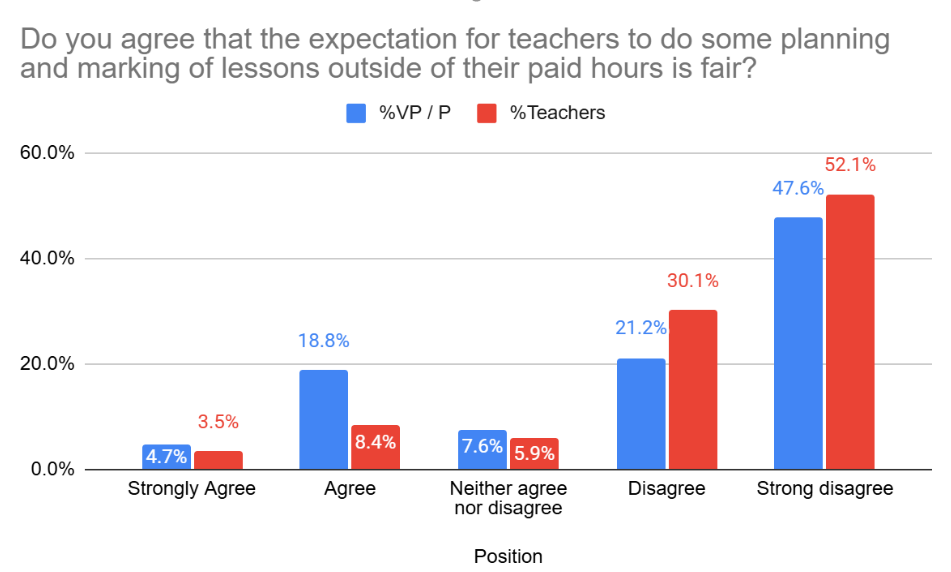
Our survey shows that most teachers, whether school leaders or classroom teachers, think that the expectation for teachers to do planning and marking of lessons outside of their paid hours is unfair. Fully 82% of teachers, and 68% of VP and Principal respondents disagreed that Jordanstown 8.1.b is fair.
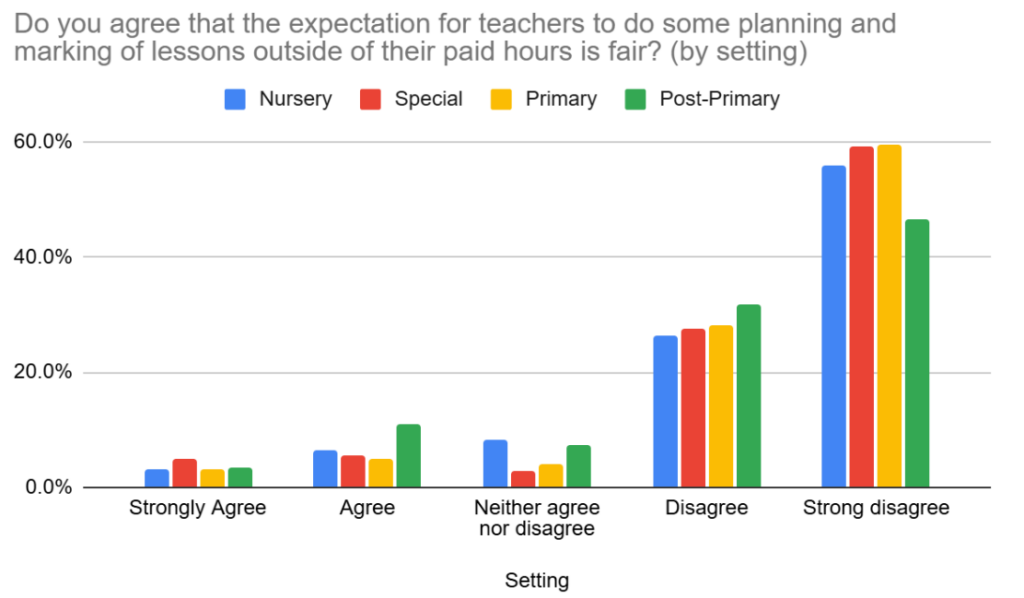
This pattern is shared across settings.
While there’s a bit of difference between the strength of disagreement between post-primary and primary teachers, the same pattern is seen regardless of school type. Teachers, wherever they teach, think 8.1.b is unfair.
Teachers think most PPA should be in school hours
60-odd percent of teachers think PPA should be in our contracted and paid hours, and half of VPs / Ps who responded agreed. Another 30% said that most PPA should be in school hours, with doing it at home being an exception rather than the rule. (This is in line with TNC 2024/2)
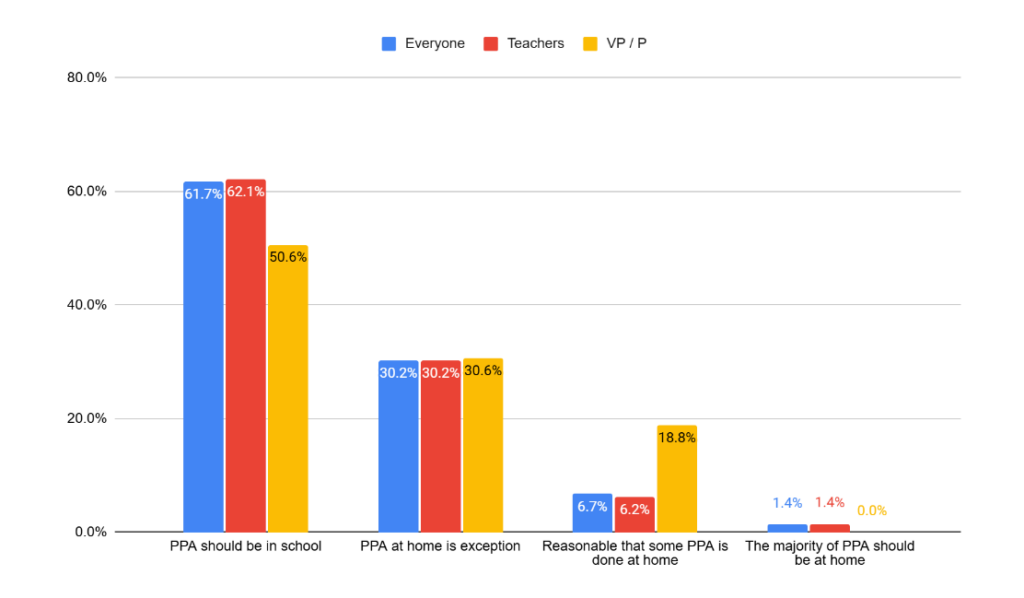
While 20% of school leaders who responded thought that it’s reasonable that some PPA is done at home, only a handful of teachers (and no school leaders) said they thought the majority should be done at home.
Teachers think this clause drives excessive workload.
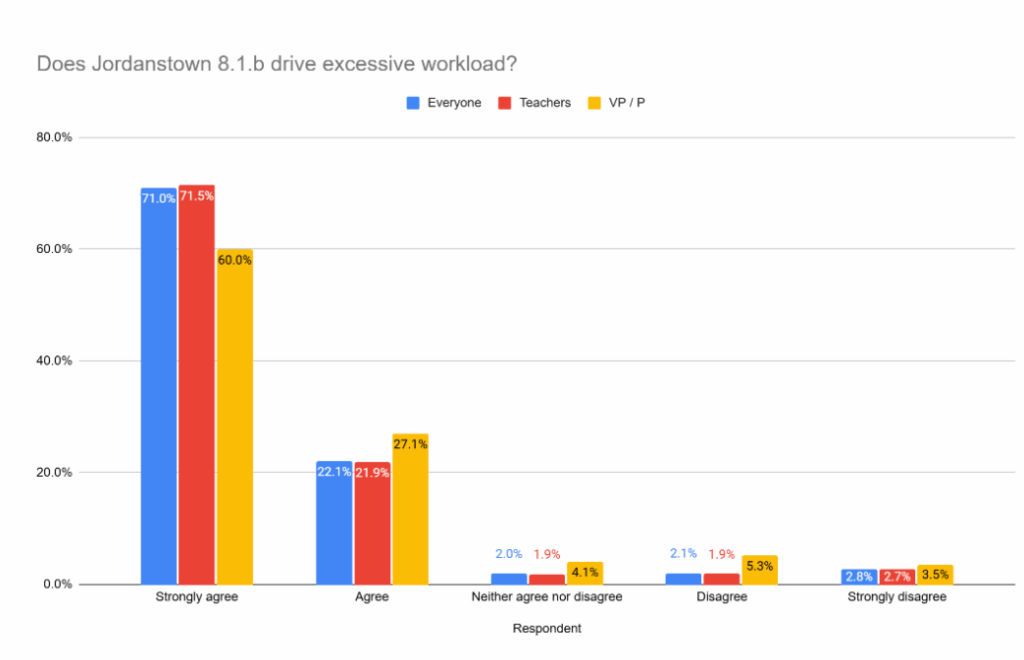
93% of teachers, and almost 80% of VPs and Principals, think that 8.1.b is driving excessive workload. Similar numbers say it is fuelling the recruitment and retention crisis.
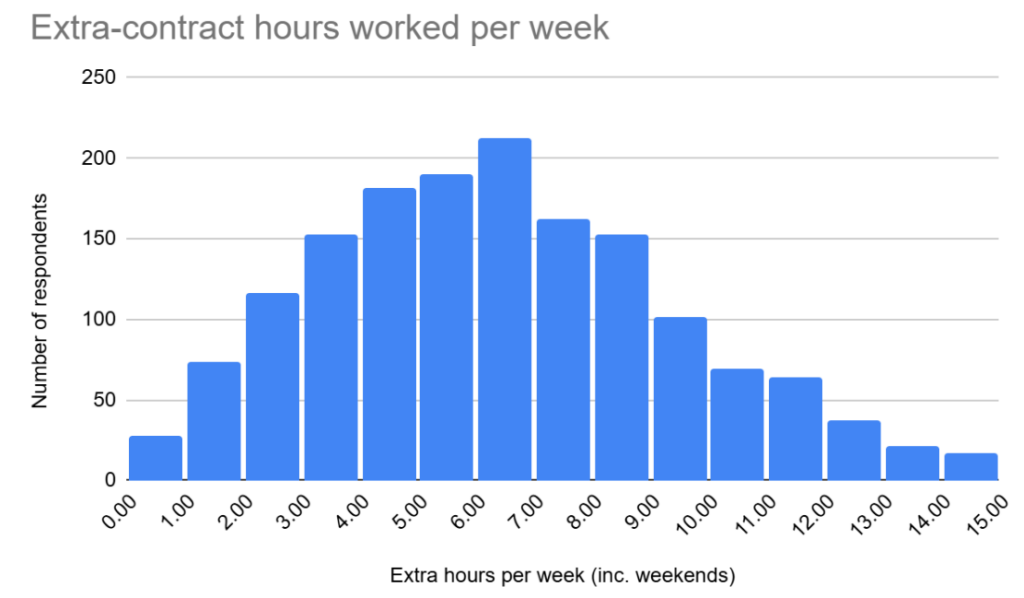
Workloads are unfairly distributed
Our data showed that teachers’ experience of excess work is exceptionally diverse. Some rarely need to take work home, while others are doing 5, 10, or 15 plus hours extra each week. Therefore workload is not being equitably distributed, contrary to TNC 2024/2.
School leaders are working crazy hours too.
The data shows that school leaders, who have no limitation to their hours in their contracts, are working many hours at home too.
Almost 20% report working more than 10 hours at home on top of their working week.
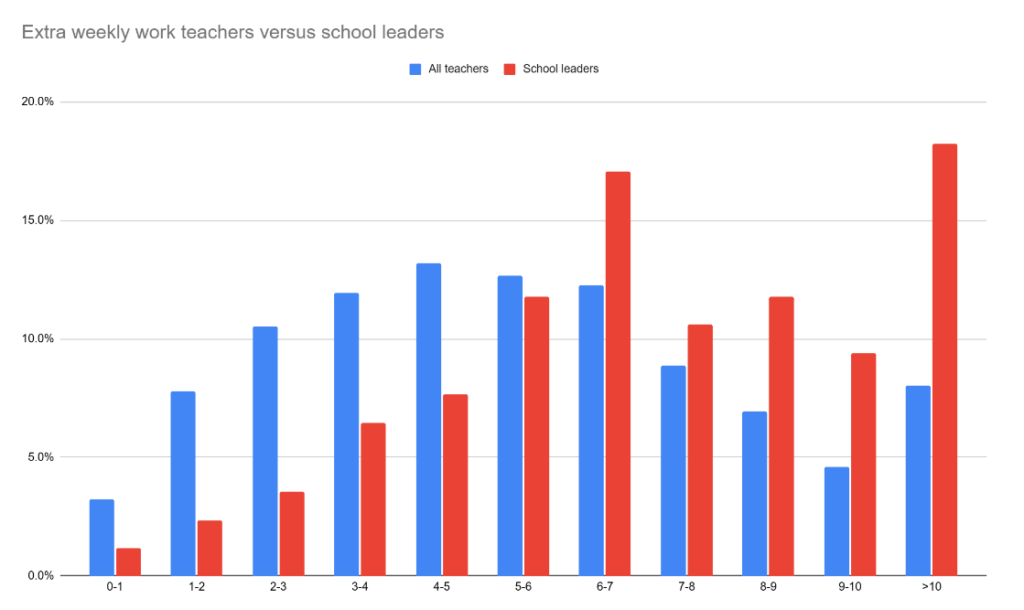
Our survey paints a picture of exhausted classroom teachers working hundreds of unpaid hours at home to keep their classes running, while equally exhausted VPs and Principals are regularly working 40 / 50 hour weeks to keep schools afloat.
While some of this free labour fits into the Zombie clause…
Jordanstown 8.1.b specifically states that teachers’ working hours are “exclusive of time spent off school premises in preparing and marking lessons.” This is the only unpaid labour the contract allows for, and even that has been contextualised and “watered down” by subsequent TNC agreements.
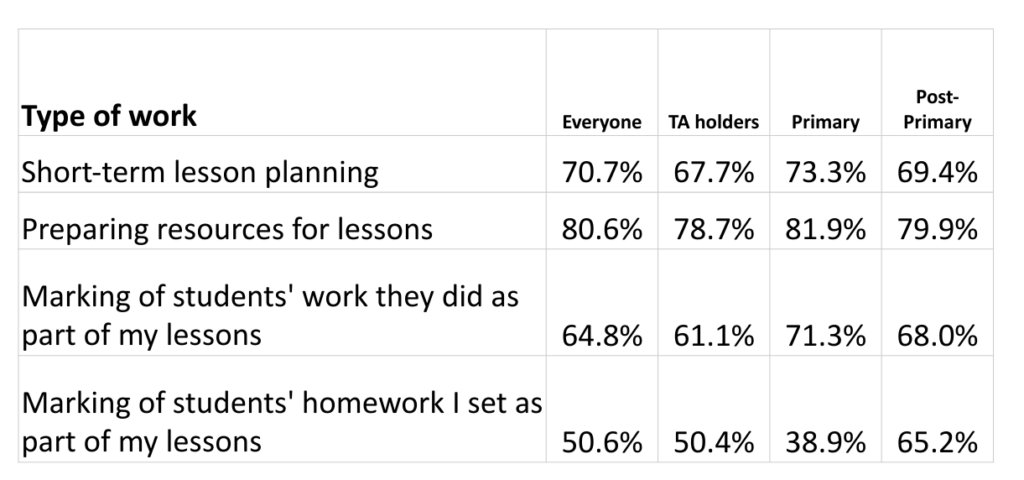
Our survey shows that a good proportion of teacher time outside of school is being spent on these tasks, even though the NITC now considers this type of work “no longer satisfactory”, and the most recent pay offer clarifies that any time spent doing this is entirely at the professional judgement of teachers themselves.
…Lots of other “professional duties” are being brought home too.
The Workload Agreement TNC 2024/2 reminds us that – with the exception of “preparing and marking lessons” – all other teachers’ work must take place in the 1265 hours of directed time. Our survey shows that this is not happening for many teachers, and that there’s an interesting division in some tasks between Primary and Post-primary colleagues.
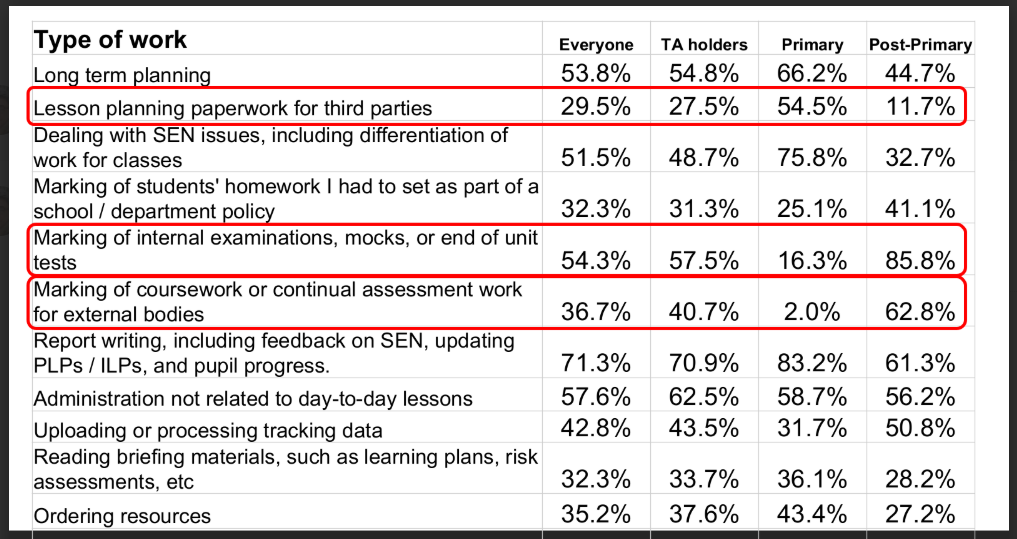
None of the tasks above can be considered “preparation and marking of lessons”, and therefore they should all be carried out within the 1265 hours of the teachers’ contract. This is not an “even better if” situation: this is your contractual right since 1987.
Zero teachers – none, nada, zilch – reported only doing “8.1.b compliant” work at home. Every single teacher brought other professional duties home during the year.
Note the sections outlined in red, which show disparities between settings. 54% of primary teachers are spending their own time, unpaid, completing planning paperwork in order to facilitate managers assessing the quality of their… planning paperwork. While think1265 fully recognises the importance of having both short and long-term plans for successful teaching, insisting that these plans are outlined in a formal, overly-detailed, way is the preserve of teacher training colleges, and should remain there.
The April 2025 pay offer included an acknowledgement from management side that “additional time needed to prepare
and mark lessons is not included in directed time and to that extent is a matter of professional judgement for teachers in meeting the needs of their role.” Therefore if a Principal wants a teachers to complete planning documentation to a certain standard for inspection by line managers in the school, this is a direction and the teacher must be given time to do this job in their paid hours.
In post-primary we see the impact of examination and test marking, along with the perennial problem of coursework marking and paperwork. Teachers are required to do this type of assessment as part of their professional duties, which means this is a direction from their Principal.
And every direction must be provided with sufficient time to complete that work within the 1265 hours.
There is no possible reading of Jordanstown 8.1.b which justifies a teacher marking examinations, tests or coursework, unless they have decided themselves to set this work as part of their lessons.
Do Directed Time budgets help with this?
There is little difference between the time worked at home and whether or not staff received a Directed Time budget, with one really important exception.
Those staff who had a meaningful discussion with their Principal about their DTB, and that discussion resulted in a change to their DTB, had a significantly higher chance of working fewer extra hours when compared to those who didn’t.
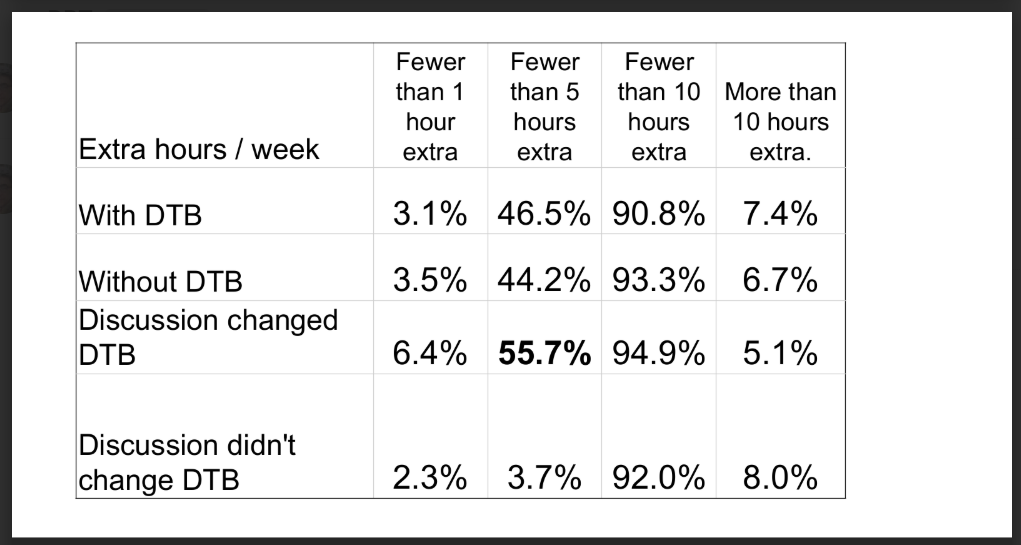
This is a small signal in a lot of noise, but it shows that teachers are better off if they have a discussion about their DTB, and if that discussion allowed variation of their DTB in order to meet their needs.
This is perfectly sensible, and is exactly what should be happening… in fact, this should have been happening for the last 40 years.
NB: further work will be needed on this, as it is highly likely that the time spent doing work at home is associated with the subjects being taught. As TNC 2024/2 guarantees that teachers have the right to an equitable workload, this is an important area of further study.
Most teachers are doing at least some work during holidays and weekends.
91% of teachers say they work through their unpaid lunch, while almost all school leaders do this.
Four out of five teachers, and almost all school leaders, work at weekends.
84% of teachers are doing some work during their unpaid summer holidays, while just 30% say they do no work during the Christmas break.
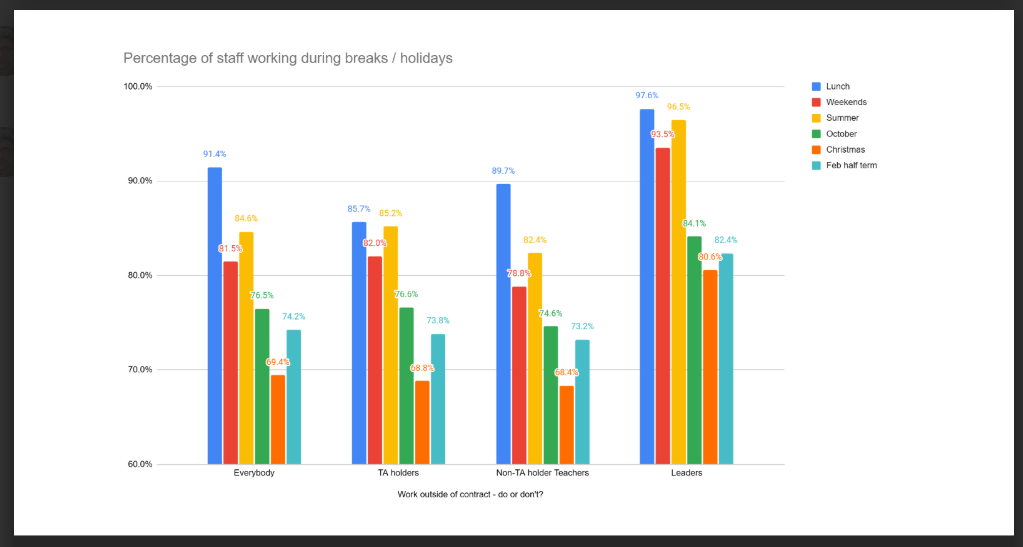
School teachers are not paid for holidays or weekends, unlike most other professions. A teacher earns their money by working the 1265 hours of directed time, and every second they spend on top of that time working on school work is free labour.
What if all this free labour was paid?
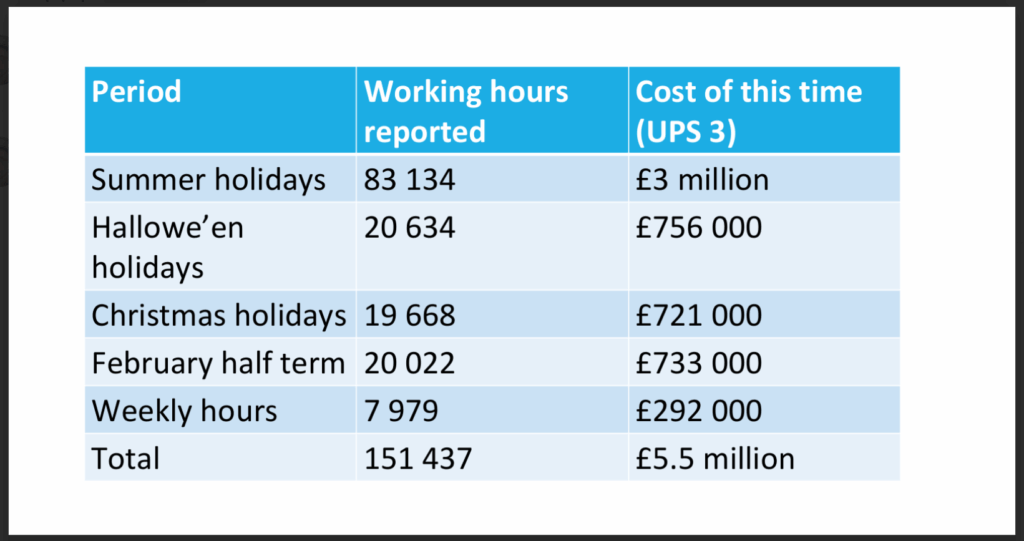
The graphic above shows the actual reported hours of extra work by staff in our survey, multiplied by the UPS3 pay rate to give an hourly amount. Since this was work done over half a school year, we can multiply that amount by two to estimate the total free labour per year: £11 million for 4186 staff. Note – this is likely an underestimate, as for many schools workload increases in April / May as deadlines approach.
Since approximately one-fifth of teachers in Northern Ireland responded to our survey, we can extrapolate these figures to account for the remaining teachers. Obviously this is a “guesstimate”, but it gives a useful figure to consider.
Our survey estimates that the total annual value of teachers’ free labour in Northern Ireland is £55 million.
Conclusion
There is a wealth of additional information which can be gleaned from this survey, but the core message is clear:
- Most teachers in Northern Ireland are regularly working additional unpaid hours at home in order to achieve their core job.
- For decades this has been justified as “just part of the job”, and teachers have been told that this work is “contractual” because it’s “in the Jordanstown Agreement.” The fact is that the majority of work teachers are doing at home should – contractually – be done during dedicated time provided to them in their paid 1265 hours in school.
- A strong majority of teachers think that this clause in their contract is unfair, and that most PPA should be done during their paid hours in school, and any planning, prep or marking outside of their paid hours should be an exception.
- Most teachers think that the culture of bringing work home is driving excessive workload and fuelling the recruitment and retention crisis.
- The distribution of work is unfair. Some teachers end up doing 5, 10 or 15 hours a week extra on a regular basis, while others only work a few extra hours, if that. Well over half of school leaders, with their open-ended contract and no limit to their hours, work over 5 hours per week extra, outside of school operating hours.
- Most teachers work most lunchtimes, weekends and holidays, all of which is unpaid labour.
- While a few of the tasks that teachers do could be justified by Jordanstown 8.1.b, the majority of work brought home consists of professional duties which should be – under contractual rules – carried out as part of teachers’ paid 1265 hours, and time-budgeted for.
- While time budgets themselves don’t seem to help much at present, a majority of teachers who had a meaningful discussion which resulted in their DTB getting changed to suit their workload, worked fewer extra hours than teachers who were unable to have their DTB tweaked. So communication and discussion about staff needs really makes a difference.
Good Friday
Designed and produced by teachers and trade unionists. While every effort has been made to ensure the accuracy of information on this site, teacher and union representatives are advised to contact their own trade union reps before taking action which might leave them in breach of contract. Think1265 uses WordPress, which uses cookies for functionality. Think1265 does not use any cookies for any purpose other than those used by WordPress for site functionality, and no personal information is retained or processed by think1265 without users’ specific permission. © 2026 think1265